
Bhagwan Ayyappa – Dharma Sastha
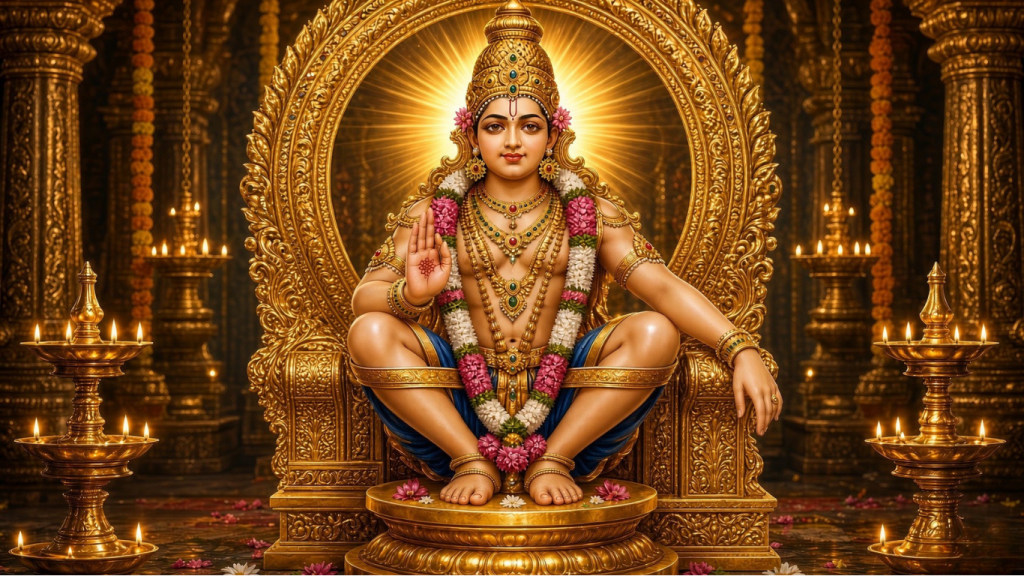
Swamiye Saranam Ayyappa
There are deities we go to see. And then there is Bhagwan Ayyappan, for whom the devotee first changes himself before beginning the journey.
A pilgrimage to Sabarimala does not begin at Pamba. It does not begin at Erumeli, Nilakkal, or even on the day the Irumudi is tied.
It begins when a devotee wears the Mala, bows his head and says:
Swamiye Saranam Ayyappa
From that moment, the journey is as much inward as it is towards the sacred hill.
During the Vratham, the devotee begins to simplify his food, thoughts, speech, habits and way of living.
Ordinary distinctions begin to fall away.
The devotee is called Swamy. The person beside him is Swamy.
Rich or poor. Employer or worker. Young or old. Experienced pilgrim or Kanni Swamy.
Before Ayyappa, worldly titles begin to lose their importance.
Who is Bhagwan Ayyappa?
Bhagwan Ayyappa is worshipped as Dharma Sastha — the protector, teacher and upholder of Dharma.
He is lovingly known by many names, each carrying a part of His story and meaning.
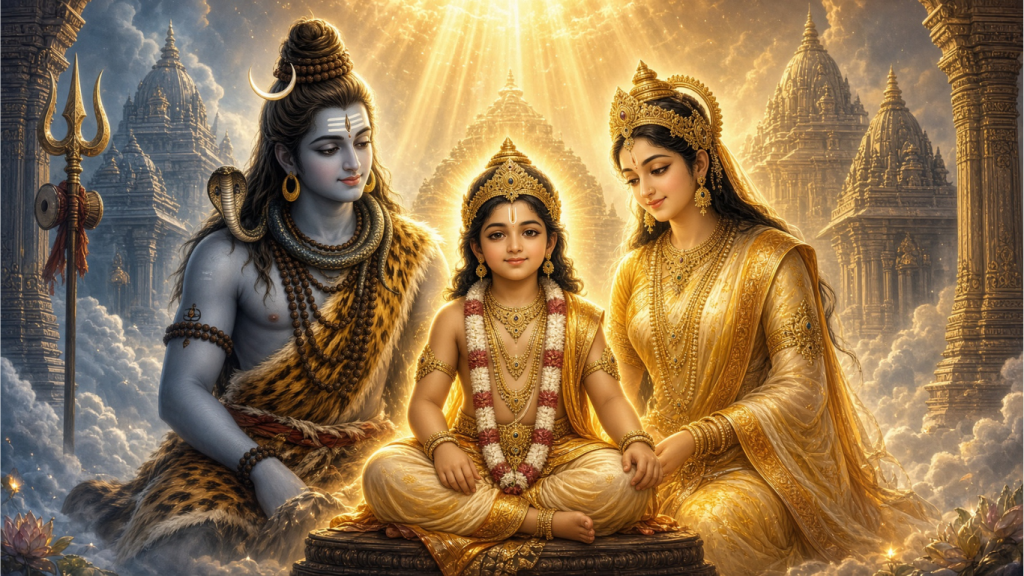
Hariharaputra — the son associated with Hari and Hara, Vishnu and Shiva.
Manikandan — the divine child of the sacred tradition.
Dharma Sastha — the one who teaches and protects righteous living.
Ayyappa — the beloved Bhagwan to whom devotees surrender with the chanting:
Swamiye Saranam Ayyappa
The traditional account of His divine origin itself carries a beautiful message.
Ayyappa is associated with the divine union of Bhagwan Shiva and Mohini, the form assumed by Bhagwan Vishnu.
For the devotee, there is a profound teaching here.
Ayyappa stands beyond divisions.
Shaiva and Vaishnava meet in Him.
Social status disappears before Him.
Different languages, regions and backgrounds need not divide those who walk towards Him.
On the path to Ayyappa, the devotee repeatedly encounters one truth: Dharma is greater than ego and identity.
Dharma Sastha & Ayyappan Understanding the Difference
One of the most important things an Ayyappa devotee should understand is that Dharma Sastha and the Ayyappan worshipped at Sabarimala should not simply be treated as identical descriptions without understanding the tradition behind them.
At Sabarimala, Bhagwan Ayyappa is worshipped as a Naishtika Brahmachari — one established eternally in Brahmacharya.
This is the form before whom the devotee undertakes Vratham, carries the Irumudi and climbs the sacred Pathinettampadi.
Yet Dharma Sastha is worshipped in other sacred Kshetrams in different forms.
In the tradition followed and taught in our Kshetram, Dharma Sastha is associated with Purna and Pushkala in the Grihastha form, while the Ayyappan of Sabarimala is worshipped as the Naishtika Brahmachari.
This distinction is important.
Otherwise a devotee may naturally ask:
“If Dharma Sastha is associated with Purna and Pushkala, how can Ayyappa be a Brahmachari?”
The answer lies in understanding the different manifestations and purposes through which the Divine appears.
The Sabarimala Ayyappan whom we approach through Vratham and Yatra is the Naishtika Brahmachari form.
The Earlier Manifestation of Dharma Sastha
In the tradition handed down to us, the story begins long before the appearance of Manikandan on the banks of Pamba.
The Asura Bhasmasura undertook severe penance and received a boon from Bhagwan Shiva.
Through that boon, whoever Bhasmasura placed his hand upon would be reduced to ashes.
After receiving this extraordinary power, Bhasmasura attempted to test the boon upon Bhagwan Shiva Himself.
Bhagwan Shiva moved away from him, and it was then that Bhagwan Vishnu assumed the enchanting form of Mohini.
Through divine wisdom, beauty and dance, Mohini caused Bhasmasura to imitate her movements.
Eventually Bhasmasura placed his own hand upon his head.
The very boon he had obtained became the cause of his destruction.
After these events, Bhagwan Shiva beheld the divine form of Mohini.
From the divine union of Bhagwan Shiva and Mohini — the form of Bhagwan Vishnu — Dharma Sastha manifested.
Thus Sastha is remembered as Hariharaputra — the son arising through Hari and Hara.
In the tradition received by us, this Dharma Sastha later belongs to the Grihastha form and is associated with Purna and Pushkala.
This is an important part of the story because the appearance of Manikandan at Pamba occurs much later, for a different divine purpose.
The Rise of Mahishi
Much later came Mahishi.
Mahishi undertook severe penance seeking extraordinary protection.
She wanted to avenge the death associated with her lineage and believed that she could make the conditions of her own destruction almost impossible.
According to the tradition taught to us, Mahishi sought conditions that would make it extraordinarily difficult for anyone to overcome her.
The one destined to destroy her would have to arise from the divine union of Bhagwan Shiva and Bhagwan Vishnu.
To Mahishi, this appeared impossible.
But what Mahishi did not know was that the divine union of Bhagwan Shiva and Mohini had already taken place.
The possibility she considered impossible had already existed within Divine Will.
Why Did Manikandan Have to Reach the Age of Twelve?
This is one of the most important questions in the story of Bhagwan Ayyappa.
If the Divine had appeared only to destroy Mahishi, why would He need to wait?
Why not at the age of five?
Why not eight?
Why not nine or ten?
Hindu tradition itself contains stories of divine children accomplishing extraordinary deeds at a very young age.
Bhagwan Krishna, for example, overcame powerful destructive forces while still a child.
Mahishi knew that divine power could appear through a child.
Therefore, according to the tradition handed down to us, her protection was not based only upon the impossible parentage of the child.
There were further conditions.
Even if such a child were somehow born, the appointed purpose would not be fulfilled until the child reached the age of twelve.
Twelve years itself carries significance within Hindu sacred reckoning and is associated with a complete Pushkara cycle.
This also gave Mahishi time.
If such an extraordinary child were born, she believed she would have enough time to discover who he was and where he lived.
The waiting was therefore not weakness.
The waiting was part of the condition.
Why Did the Child Have to Grow in a King’s Household?
According to the tradition we follow, another important condition was that the child would have to grow within the household of a king.
Mahishi’s reasoning was understandable.
In ancient times, if an extraordinary prince were born in a great kingdom, the event would be celebrated.
The birth of a royal heir would become known far beyond the palace.
Messengers, celebrations and public announcements would make such a child difficult to hide.
Mahishi believed that if the impossible child were ever born, she would eventually hear about him.
But Divine Will fulfilled the condition in a way she did not expect.
The child would indeed be raised by a king.
But not in the kind of vast and powerful imperial court Mahishi had imagined.
He would be raised in Pandalam, under King Rajasekhara.
The condition would be fulfilled.
Yet the child could still grow away from the kind of attention Mahishi expected.
Every condition she depended upon for protection would ultimately be satisfied — but not in the manner she had imagined.
The Divine Child Manikandan
According to the traditional Sabarimala account, the divine child was found near the sacred Pamba by King Rajasekhara of Pandalam.
To those who saw Him, He appeared to be a child who had been left near the river.
But His appearance there was not without purpose.
King Rajasekhara took the child into his home and raised Him with love.
The child came to be known as Manikandan.
But Manikandan was no ordinary prince.
He grew within the royal household while His true divine purpose remained hidden.
The very circumstances of His upbringing were gradually fulfilling the conditions connected with the mission for which He had manifested.
As Manikandan grew, His wisdom, courage and extraordinary nature became increasingly evident.
But the appointed time had not yet arrived.
He had to grow.
He had to remain within the king’s household.
And He had to reach the age connected with the condition surrounding Mahishi.
When Manikandan reached the appointed age, the purpose of His manifestation began to reveal itself.
The child who had quietly entered the household of King Rajasekhara was now ready to confront the force that believed itself protected by an impossible boon.
Manikandan overcame Mahishi.
The conditions were fulfilled.
The boon was not broken.
It was fulfilled perfectly in a way Mahishi had never anticipated.
The Tigress and the Revelation of Manikandan
After the destruction of Mahishi came another event through which the true nature of Manikandan would become impossible to conceal.
Circumstances within the palace led to the demand that Manikandan bring back the milk of a tigress.
To an ordinary human being, such a task would appear impossible.
Manikandan entered the forest.
But He did not return as an ordinary prince.
He returned in divine glory.
The palace that had raised Him now began to understand whom it had actually been blessed to receive.
The child found near Pamba was not merely a royal son.
He was Ayyappan.
From Manikandan to Sabarimala
After His divine purpose had been fulfilled, Manikandan did not seek the throne of Pandalam.
He did not remain for wealth, succession or worldly authority.
Tradition remembers Him directing King Rajasekhara towards the sacred place where His presence would remain for generations of devotees.
There, upon the sacred hill, devotees would not approach Him casually.
They would prepare themselves through:
Vratham.
Brahmacharya.
Discipline.
Irumudi.
Surrender.
Dharma.
And there He would be worshipped in the form that defines Sabarimala:
Bhagwan Ayyappa — the Naishtika Brahmachari.
Swamiye Saranam Ayyappa.
Sabarimala Is More Than a Destination
To understand Bhagwan Ayyappa, one must understand something essential:
Sabarimala is not merely a destination.
A devotee traditionally does not prepare for this pilgrimage as he would prepare for an ordinary journey.
There is the Mala.
There is the Vratham.
There is discipline in food, thought, speech and conduct.
There is prayer.
There is simplicity.
There is the Irumudi.
There is the journey through the sacred landscape.
There is the ascent.
And finally, there is Darshan.
Every part of the pilgrimage prepares the devotee not merely to reach a temple, but to arrive before Bhagwan Ayyappa in a different state of mind from the one in which he began.
That is why the journey to Sabarimala cannot be measured only in kilometres.
Its real distance is between the person who wears the Mala and the person who finally stands before Ayyappa.
Why Every Devotee Becomes “Swamy”
One of the most beautiful traditions of Ayyappa worship is the way devotees address one another.
Swamy.
This is not merely a greeting.
It is a teaching.
When you call another devotee Swamy, you are being reminded to recognise the divine within him.
When another devotee calls you Swamy, you are being reminded that your own conduct should become worthy of that name.
Profession does not matter.
Wealth does not matter.
Position does not matter.
Language does not matter.
The person walking beside you may come from a completely different background, region or way of life.
But on the path towards Ayyappa, those differences begin to lose their importance.
He becomes:
Swamy.
And your response is:
Saranam Ayyappa.
During the Vratham, this way of addressing one another becomes a constant reminder of humility.
It teaches the devotee to look beyond ordinary social identity and remember that every person on the path is walking towards the same Bhagwan.
The word “Swamy” is not only what we call another devotee. It is also a reminder of how we are expected to behave.
What Does “Saranam” Mean?
Throughout the Ayyappa Vratham and Yatra, one word is heard again and again:
Saranam.
The word is often translated as refuge, shelter or surrender.
But for an Ayyappa devotee, its meaning gradually becomes much deeper than a dictionary translation.
When we say:
Swamiye Saranam Ayyappa
we are not merely repeating the name of Bhagwan Ayyappa.
We are placing ourselves before Him with humility.
We are saying:
My ego need not guide me.
My habits need not control me.
My anger need not rule me.
My difficulties need not define me.
I surrender myself to Dharma and ask for the strength to walk the right path.
During the Vratham, the devotee may repeat Saranam hundreds or even thousands of times.
Yet the words need not remain the same within him.
At the beginning, they may simply be something he has been taught to chant.
As the days of discipline pass, the same words can begin to carry the weight of his own experiences, struggles, prayers and surrender.
A difficult day may give the word one meaning.
A moment of prayer may give it another.
The climb towards Sannidhanam may give it another.
And standing before Bhagwan Ayyappa may make the same words feel completely different again.
Saranam is not merely something the devotee says. It is something the devotee gradually learns to live.
When the mind becomes disturbed:
Saranam Ayyappa.
When the body becomes tired:
Saranam Ayyappa.
When pride begins to rise:
Saranam Ayyappa.
When the journey becomes difficult:
Saranam Ayyappa.
And when the devotee finally stands before Bhagwan Ayyappa, sometimes there is nothing more to ask.
There is only:
Swamiye Saranam Ayyappa.
The Sacred Irumudi
The Irumudi is one of the most sacred parts of the Sabarimala Yatra.
It is not simply a travel bag.
It is not ordinary luggage.
And it is not carried merely because tradition requires it.
The Irumudi represents the devotee’s preparation, discipline and surrender as he approaches Bhagwan Ayyappa.
Traditionally, it is prepared and tied with guidance, care and reverence.
What it contains, how it is arranged, how it is carried and how it is used during the pilgrimage all have meaning.
The Irumudi also marks an important distinction in the journey.
The devotee carrying it is not simply travelling to a temple.
He is completing a period of Vratham and approaching Sannidhanam in the traditional way taught through generations of Ayyappa worship.
The Irumudi should never become a prop for a photograph.
It is sacred because of the Vratham behind it.
Without discipline, the outer form loses its inner meaning.
For the devotee, the Irumudi carries more than offerings.
It carries the seriousness of the journey.
It carries the days of Vratham.
It carries prayer.
It carries surrender.
And it is carried towards Bhagwan Ayyappa.
The Irumudi is not about what rests on the head. It is about what has already changed within the devotee.
On this website, we explain the practical preparation of the Irumudi separately in the Yatra section, including its traditional structure, contents and the way it is handled during the pilgrimage.
The Eighteen Sacred Steps Pathinettampadi
For many devotees, one of the most powerful moments of the entire Sabarimala Yatra is standing before the sacred Pathinettampadi — the Eighteen Steps.
They are not merely an entrance to the temple.
They are one of the defining sacred experiences of the pilgrimage.
The devotee reaches them only after the Vratham, the journey, the Irumudi and the ascent towards Sannidhanam.
By the time he stands before the steps, the journey has already asked much of him.
He has carried discipline.
He has carried prayer.
He has carried fatigue.
He has carried surrender.
And now he stands before the final sacred ascent towards Bhagwan Ayyappa.
The Eighteen Steps are not simply climbed. They are approached.
Traditions explain the deeper symbolism of the 18 sacred steps in different ways, and Guruswamy lineages may emphasise different meanings.
That is why we should approach their interpretation with care and respect.
What remains central is this:
The devotee carrying the Irumudi approaches Pathinettampadi as the culmination of his Vratham and Yatra.
Each step becomes part of the final movement from preparation towards Darshan.
By the time the devotee reaches the Eighteen Steps, the question is no longer only how far he has travelled — but what he has left behind within himself.
For some, the moment is filled with excitement.
For some, tears.
For some, silence.
And for many, only one chant rises naturally:
Swamiye Saranam Ayyappa.
We will explore the traditional meanings associated with the Eighteen Sacred Steps separately on this website, along with the role of the Irumudi and the discipline connected with approaching them.
The Lord Who Waits on the Hill
There is something about Sabarimala that is difficult to explain to someone who has never undertaken the journey.
After the Vratham…
After the prayers…
After wearing the Mala…
After tying the Irumudi…
After leaving home…
After the journey…
After Pamba…
After the ascent…
There finally comes a moment when the devotee stands before Bhagwan Ayyappa.
And suddenly, many things that seemed important before the Vratham begin to feel very small.
For some devotees there are tears.
For some there is silence.
For some, the mind becomes completely still.
And for many, only one chant rises naturally:
Swamiye Saranam Ayyappa.
In that moment, the devotee is no longer thinking about how many kilometres he travelled.
He is not thinking about how difficult the climb was.
He is not thinking about how many people were around him.
He is not thinking about the world he left behind.
For those few moments, there is only the devotee and Bhagwan Ayyappa.
Sometimes a few moments before Ayyappa explain what pages of philosophy cannot.
And when the Darshan is over, the devotee begins the journey back.
But something within him should not return exactly as it was.
Because the true purpose of the Yatra is not only to reach Sannidhanam.
It is also to allow Sannidhanam to remain within the devotee.
Ayyappa Is Not Only a Mandala-Season Bhagwan
For many devotees, Bhagwan Ayyappa becomes especially visible during Mandala Kalam.
The Mala is worn.
The Vratham begins.
Groups of Swamys prepare for Yatra.
The chanting of Swamiye Saranam Ayyappa is heard everywhere.
But Bhagwan Ayyappa is not only a seasonal presence.
He does not become Ayyappa only during Mandala Kalam and disappear when the pilgrimage season ends.
Sabarimala opens at prescribed times during the year, including monthly openings and special occasions.
The crowds may change.
The season may change.
The weather may change.
But Dharma does not change with the calendar.
Vratham does not become meaningful only because a particular month has arrived.
Devotion does not become sacred only because the hill is crowded.
The deeper question begins after the devotee returns home.
How much of the Swamy who climbed Sabarimala remains within us during the rest of the year?
Do we carry the same discipline?
Do we remember the same humility?
Do we control our anger the same way?
Do we speak with the same restraint?
Do we remember Dharma when there is no Mala around our neck?
Do we remember Ayyappa when there is no Yatra ahead of us?
Because the true success of the pilgrimage is not only:
“I reached Sannidhanam.”
It is also:
“Something of Sannidhanam returned home with me.”
Bhagwan Ayyappa is not only the Bhagwan we seek on the sacred hill.
He is also the reminder we carry into everyday life.
What Bhagwan Ayyappa Teaches the Devotee
The path of Bhagwan Ayyappa continually brings the devotee back to a few simple but powerful truths.
Devotion without show.
Discipline without arrogance.
Strength without cruelty.
Equality without distinction.
Simplicity without weakness.
Dharma even when nobody is watching.
Surrender without fear.
The Mala will eventually be removed.
The Irumudi will eventually be emptied.
The Yatra will come to an end.
The clothes worn during Deeksha will eventually return to the cupboard.
But if the Vratham has truly touched the devotee, something should remain.
A little less ego.
A little more patience.
A little more discipline.
A little more compassion.
A little more control over anger.
A greater awareness of Dharma.
And a deeper remembrance of Bhagwan Ayyappa.
The real measure of the Yatra is not only how many times we reached Sabarimala, but how much of Ayyappa remained within us after we returned.
A devotee may count the number of Yatras he has completed.
But the deeper question is:
How many of those Yatras changed the way he lives?
That is the teaching the path of Ayyappa continues to place before us.
From Our Kshetram
At Sabarimala Ayyappa Teertha Kshetram, we believe that the path of Bhagwan Ayyappa must be understood through both devotion and discipline.
The teachings shared here are not meant to reduce the Yatra to a checklist.
They are meant to help the devotee understand why the Vratham matters, why the Irumudi is sacred, why the Pathinettampadi is approached with reverence, and why the journey to Sabarimala continues to transform people generation after generation.
Much of what we share comes from years of undertaking Vratham, travelling to Sabarimala, learning from Guruswamy tradition, observing the practices of devotees, and reflecting on the deeper meaning behind the journey.
Different families, regions and Guruswamy lineages may follow certain customs differently.
Where such differences exist, they should be approached with humility and respect.
Our purpose is not to compete with tradition.
Our purpose is to preserve it, explain it, and pass it forward with sincerity.
May every devotee who begins this path do so with understanding, discipline and surrender.
Swamiye Saranam Ayyappa.
Continue Your Journey
Understand Ayyappa Vratham.
Learn the purpose, discipline and daily practices of the sacred Deeksha.
Prepare for Sabarimala Yatra.
Understand the Irumudi, the sacred journey, conduct and preparation for Darshan.
Understand the Eighteen Sacred Steps.
Explore the meaning and tradition surrounding Pathinettampadi.